
Medical Disclaimer
This article is for informational purposes only and does not substitute professional medical advice, diagnosis, or treatment. Always consult a qualified healthcare provider before making any health-related decisions.
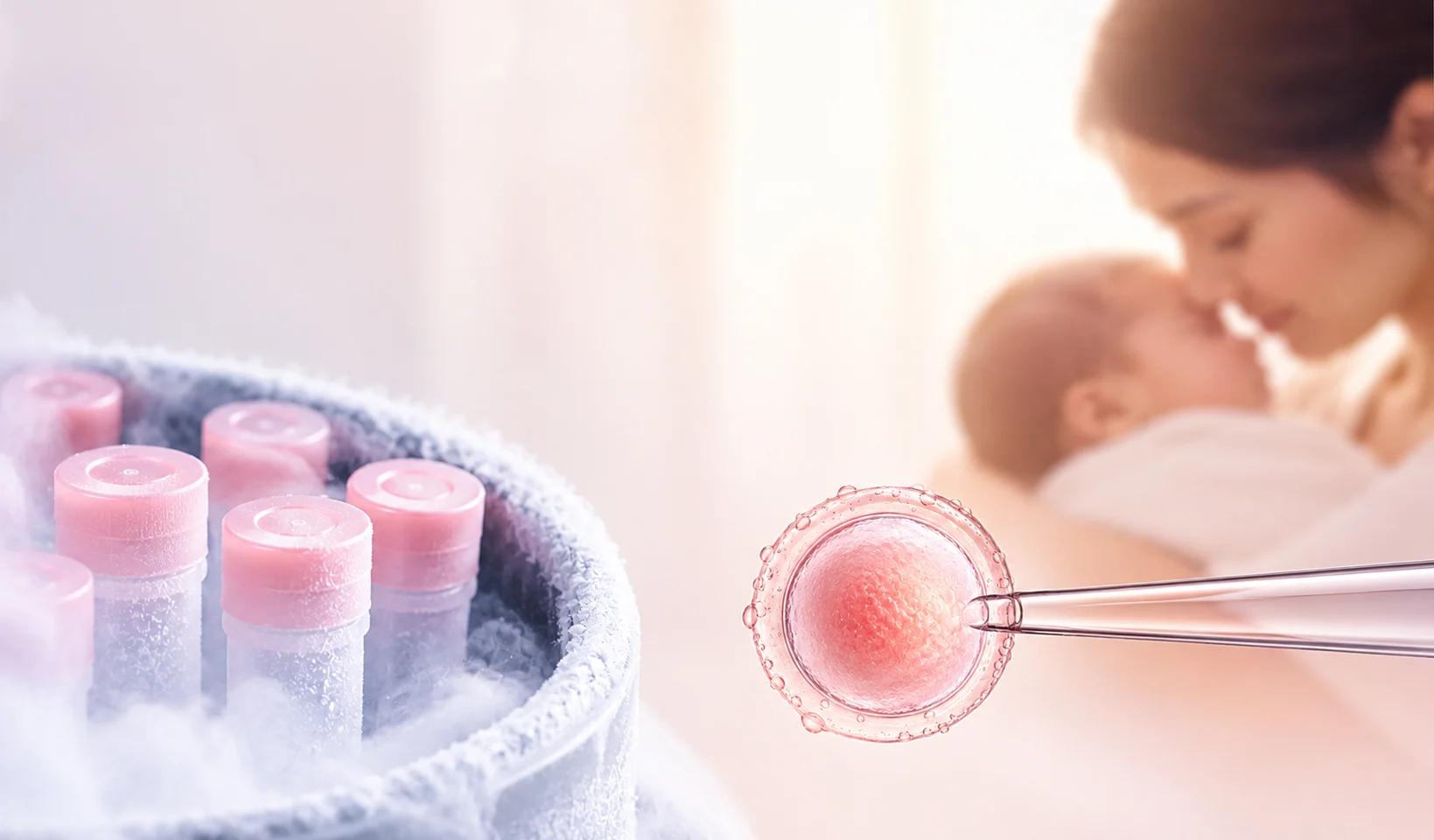
Frozen Egg Success Rates: How Many Eggs Survive Thawing and What Are the Real Chances of a Baby?
If you are considering freezing eggs, you may want to know how likely they are to help you have a baby in the future. You may also come across different success rates and wonder which number applies to you.
Understanding what these figures mean can help you have a more useful discussion with your fertility specialist.
What Happens When Frozen Eggs Are Used?
Frozen eggs are warmed in the laboratory when you are ready to use them. Eggs that survive this stage may then be fertilised using sperm.
The process usually involves:
- Warming the stored eggs
- Fertilising surviving mature eggs, usually through ICSI
- Monitoring the development of embryos
- Transferring a suitable embryo into the uterus
- Checking whether pregnancy has occurred
ICSI is a method in which a single sperm is placed inside an egg to help fertilisation.
Do All Eggs Survive Thawing?
Not every frozen egg survives warming. The results can vary between laboratories and individual patients. In general, > 95% of eggs survive freezing well.
Your clinic can explain its recent results and whether they relate to patients of a similar age at freezing. This is more useful than relying on one general percentage found online.
Is Egg Survival the Same as the Chance of a Baby?
No. Survival is the first stage after warming. An egg must also fertilise, develop into a suitable embryo and lead to a pregnancy that progresses to birth.
For example, a clinic reporting a high egg-survival rate is not saying that the same percentage of patients will have a baby. Ask which outcome each figure measures.
Why Does Age Matter in Egg Freezing?
The age when eggs are collected is an important factor in their future potential. Freezing eggs preserves them at that stage; it does not reverse age-related changes that have already occurred.
Your age and overall health when carrying a pregnancy also matter. Your doctor will consider both when discussing future treatment.
How Many Eggs Should You Freeze?
There is no fixed number that guarantees a baby. Your specialist may consider:
- Your age at egg collection
- How your ovaries respond to medicines
- The number of mature eggs collected
- Whether you hope to have one child or more
- The laboratory’s treatment results
Some patients consider more than one collection cycle. Your doctor can explain whether another cycle may be useful for your circumstances.
What Should You Ask Your Fertility Specialist?
Before freezing eggs, ask:
- What do the survival and birth rates mean?
- Are the figures relevant to my age group?
- What costs are involved in storage and future treatment?
- Would another collection cycle be worth considering?
Understand Your Options Before Deciding
Freezing eggs can preserve a possibility for the future, but the decision should be based on your health, plans and realistic expectations.
At Bavishi Fertility Institute, a fertility-preservation consultation can help you understand the process and ask questions about the results relevant to your situation.
About the Author

Dr. Parth Bavishi
MBBS, MD (Obstetrics & Gynaecology)
Co-director & IVF Specialist
Dr. Parth Bavishi holds an MD in Obstetrics and Gynaecology and brings over 12 years of specialist experience as Co-director and IVF Specialist at Bavishi Fertility Institute — a group of fertility centres across India committed to helping couples realise their dream of parenthood. His clinical focus is on complex and challenging cases, including male-factor infertility and repeated IVF failure. He has received specialised infertility training at Bavishi Fertility Institute, the Diamond Institute (USA) and the HART Institute (Japan), and is the author of 'Your Miracle in Making: A Couple's Guide to Pregnancy.'