
Medical Disclaimer
This article is for informational purposes only and does not substitute professional medical advice, diagnosis, or treatment. Always consult a qualified healthcare provider before making any health-related decisions.
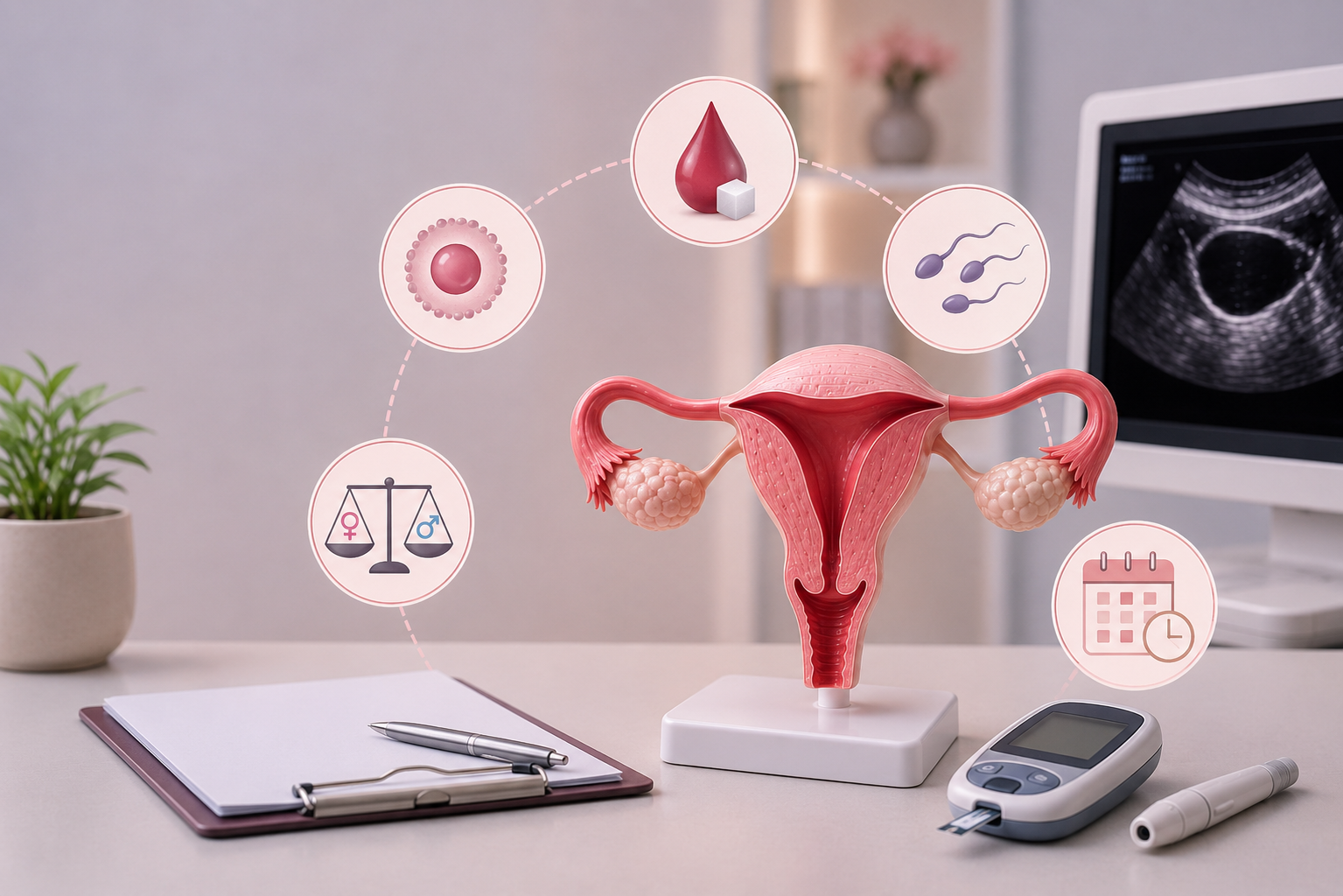
How Diabetes Affects Fertility — Not Just Pregnancy
Both
Male and female fertility are affected
PCOS
Closely linked to insulin resistance
HbA1c
Key number to optimise before trying
3 months
Typical pre-conception control window
The Short Answer
Yes — diabetes and prediabetes can affect fertility directly, not just pregnancy safety once conceived. In women, poorly controlled blood sugar can disrupt ovulation and is closely tied to PCOS. In men, diabetes is linked to lower testosterone and reduced sperm quality. The encouraging part: blood sugar control is one of the more directly modifiable factors in a fertility work-up, and improving it often has a meaningful, measurable effect.
How It Affects Women
Insulin resistance — where the body's cells don't respond normally to insulin, often the underlying issue in both prediabetes and type 2 diabetes — can disrupt the hormonal signalling that triggers ovulation each month. This can lead to irregular or absent periods, making it harder to predict or achieve ovulation at all. Poorly controlled diabetes has also been linked to a higher risk of early pregnancy loss once conception does occur.
How It Affects Men
Diabetes affects male fertility through several overlapping pathways: it's associated with lower testosterone levels, can damage the small blood vessels and nerves involved in erectile function, and has been linked in research to reduced sperm motility and higher sperm DNA fragmentation. This side of the picture is discussed far less often, but it's a real and addressable part of a male fertility work-up.
Prediabetes & the PCOS Link
This connection is worth understanding on its own: insulin resistance is present in a large proportion of women with PCOS (Polycystic Ovary Syndrome), one of the most common causes of ovulatory infertility. This means many women with PCOS-related fertility difficulty are, in effect, dealing with an early-stage blood sugar issue — sometimes before it would ever show up as "prediabetes" on a standard test. Addressing insulin resistance is often a genuinely effective part of a PCOS fertility treatment plan.
We check blood sugar and insulin resistance as part of every fertility work-up — not as an afterthought.
Testing
HbA1c + fasting insulin
PCOS Screening
Included in work-up
Male Panel
Testosterone included
Approach
Coordinated with your physician
Best suited for: Couples with a known diabetes or prediabetes diagnosis, PCOS, irregular cycles, or unexplained infertility where a metabolic cause hasn't yet been ruled out.
Pre-Conception Blood Sugar Optimisation
A focused window before you start trying.
If you're on diabetes medication, never adjust or stop it without your physician's guidance — this plan works alongside your existing care, not instead of it.
Managing Blood Sugar Before Trying
Do
Get an HbA1c test to understand your average blood sugar over the past 2-3 months.
Work with your physician on a target range specifically for pre-conception, which may be tighter than your usual target.
Prioritise consistent, moderate exercise — it independently improves insulin sensitivity.
Focus on fibre-rich, lower-glycaemic-index meals rather than an all-or-nothing diet overhaul.
Avoid
Starting or stopping any diabetes medication without your physician's involvement.
Crash diets or extreme calorie restriction right before trying to conceive.
Ignoring irregular cycles as 'just how your body is' without a hormonal work-up.
Assuming male partners don't need to be part of this conversation too.
Diabetes and IVF Specifically
Well-managed diabetes doesn't automatically lower IVF success rates. What matters most is the level of control going into your cycle — stable blood sugar supports better egg quality and a safer stimulation phase, while poorly controlled diabetes can affect both. This is exactly why blood sugar optimisation is built into the pre-cycle work-up for patients with a diabetes or prediabetes history, rather than treated as a separate issue.
| What it affects | Poorly Controlled | Well-Controlled (Our Goal) |
|---|---|---|
| Egg quality | Can be negatively affected | Supported |
| Miscarriage risk | Higher | Lower |
| Stimulation response | Less predictable | More predictable |
| Early pregnancy safety | Higher risk profile | Lower risk profile |
The BFI Message for You
Blood sugar is one of the more directly improvable factors in a fertility plan — and we treat it that way.
We check both partners, because diabetes affects fertility on both sides — not just the female partner.
We coordinate with your existing physician rather than working around them.
If PCOS and insulin resistance are both in the picture, we treat them as one connected plan, not two separate problems.
What to Expect at Bavishi Fertility Institute
Metabolic health — blood sugar, insulin resistance, and thyroid function — is part of the standard female fertility work-up at BFI, not an optional add-on. If you'd like to understand more about the PCOS-fertility connection specifically, our team can walk you through it alongside your existing diabetes care.
Managing diabetes or prediabetes and planning to try?
Book a consultation for a full fertility and metabolic work-up before you start.
About the Author

Dr. Parth Bavishi
MBBS, MD (Obstetrics & Gynaecology)
Co-director & IVF Specialist
Dr. Parth Bavishi holds an MD in Obstetrics and Gynaecology and brings over 12 years of specialist experience as Co-director and IVF Specialist at Bavishi Fertility Institute — a group of fertility centres across India committed to helping couples realise their dream of parenthood. His clinical focus is on complex and challenging cases, including male-factor infertility and repeated IVF failure. He has received specialised infertility training at Bavishi Fertility Institute, the Diamond Institute (USA) and the HART Institute (Japan), and is the author of 'Your Miracle in Making: A Couple's Guide to Pregnancy.'